The History of The Popcorn Stand
.jpg/:/cr=t:0%25,l:0%25,w:100%25,h:100%25/rs=w:400,cg:true)
An Iowa Falls Tradition
A history of popcorn vending in Iowa Falls and the little stand that became a community landmark.
For generations, the sight and smell of freshly popped corn has been part of life in Iowa Falls. Long before the little metal stand in Estes Park became a landmark, popcorn vendors operated from carts, wagons and small street stands throughout downtown. The story is therefore bigger than one building. It is a story of changing locations, family businesses, band concerts, community celebrations and generations of Iowa Falls residents gathering around a simple bag of popcorn.
1890's-Popcorn Comes to the Streets

Popcorn itself has ancient roots, but the familiar commercial popcorn vendor developed much later. In the late 1800s, steam-powered machines originally designed to roast nuts, made it possible to prepare popcorn quickly and take it directly to crowds at fairs, celebrations and busy streets. The late 1800s were an important time in the history of popcorn. Charles Cretors developed a steam-powered popcorn machine in the 1890s, helping transform popcorn into a food that could easily be prepared and sold by street vendors. By the turn of the century, popcorn carts equipped with popping machines were becoming a familiar sight across America. Iowa Falls was part of this growing tradition.
1892-An Early Iowa Falls Popcorn Stand
One of the earliest documented references to a popcorn stand in Iowa Falls dates to February 25, 1892, when a stand at Washington Avenue and Main Street passed into the hands of the Soper family. This establishes that Iowa Falls had a downtown popcorn tradition decades before the present stand was built.
1920's & 1930's-A Growing Popcorn Business
Ira Mackey's Stand
In April 1927, Ira Mackey purchased equipment and opened the National Peerless Popcorn Bungalow next to the Ellsworth building on Washington Avenue. His was one of several popcorn businesses that would operate in Iowa Falls during this era.
-In May 1931, newspapers reported that Mackey was having his popcorn stand repainted in preparation for the summer season at the corner of Oak Street and Washington Avenue.
-October 1933- Ira Mackey's stand made the news for a much less pleasant reason. Two eight-year-old boys broke into his stand at Oak Street and Washington Avenue. They broke a rear window with a stone, reached inside and unlatched the door. The boys reportedly took 30 cents in pennies along with candy and chewing gum and destroyed popcorn. Total damages were estimated at $4.50.
M. E. Whitcomb Stand
April 1933, M. E. Whitcomb opened a stand on Stevens Street just east of Aborn's Drug Store.
Saturday-Night Life
Saturday-Night Life
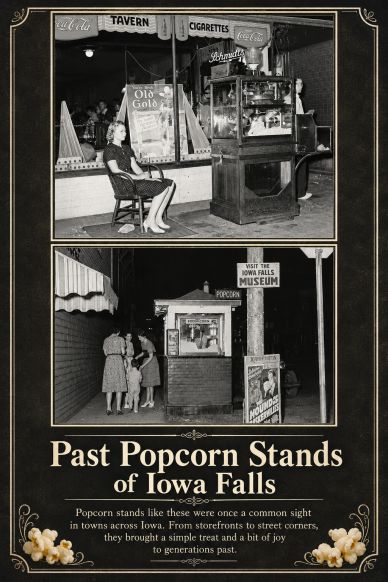
1939-Saturday night life in Iowa Falls-scenes photographed of local popcorn stands. These images are now preserved by the Library of Congress and provide a rare visual record of Iowa Falls' street-popcorn culture.
1929-Louie's Story Begins
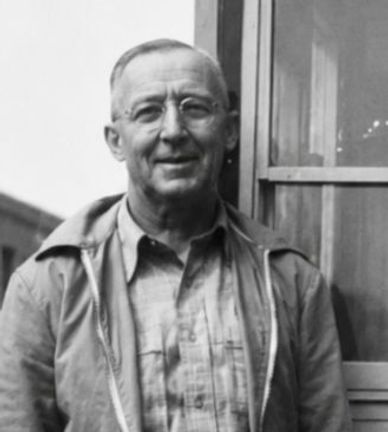
Louie Knudson and the Story of Louie’s Korn Krib
From Popcorn Wagons to An Iowa Falls Tradition
This is the beginning of the direct story that eventually leads to today's Popcorn Stand.
The history of The Popcorn Stand in Iowa Falls would not be complete without telling the story of Louis S. “Louie” Knudson. Louie wasn't simply the owner of a popcorn stand. For decades, he was known throughout Iowa Falls as “The Popcorn Man.”
His popcorn wagons, his travels to celebrations across Iowa, his generosity during World War II, and eventually Louie’s Korn Krib helped create a tradition that has survived for generations.
1919 -Louie Enters the Popcorn Business
A newspaper profile of Louie tells us that his popcorn career actually began in 1919. He started with two popcorn wagons and he and his wife, Ethel, attended dozens of celebrations around the state selling popcorn. Louie's association with popcorn began long before the familiar metal stand appeared in 1948.
1929-Ethel Encourages Louie to Build a Popcorn Stand
By 1929, Louie's popcorn business was entering another chapter. Historical information we previously uncovered tells us that Ethel Hopkins Knudson persuaded Louie to build a popcorn stand.
The Metropolitan Theatre and a Popcorn Controversy -One of the most colorful pieces of Louie's history has been preserved through his family. According to Mike Cleavenger, grandson of Louie and Ethel Knudson, one of Louie's early popcorn locations was near the Metropolitan Theatre. Louie's popcorn apparently became a little too popular. Mike confirmed that the theater did not appreciate having Louie's popcorn business competing with its own concessions. The competition eventually resulted in Louie having to move his stand. It was not a decision that everyone quietly accepted. According to Mike, his grandmother Ethel was quite upset about the situation. While the details of the disagreement have been preserved through Knudson family history rather than a newspaper account we have located so far, the story offers a wonderful glimpse into just how established Louie's popcorn business had become in downtown Iowa Falls.
The Depression Years
The timing of Louie's new venture turned out to be significant. The Great Depression began in 1929. While many Americans had little money for luxuries, popcorn remained an inexpensive treat. A bag could be purchased for only a few cents. Across the country, popcorn businesses actually flourished during this difficult period because popcorn was affordable to produce and affordable to buy. The same inexpensive treat became part of summer evenings in Iowa Falls.
1931 — A Young Bill Riley Sells Popcorn
One of the wonderful stories connected to Louie's stand comes from Iowa Falls' own Bill Riley.
That wonderful account helps show that the Popcorn Stand wasn't simply a place to purchase popcorn. It was already becoming part of the social life surrounding Estes Park.

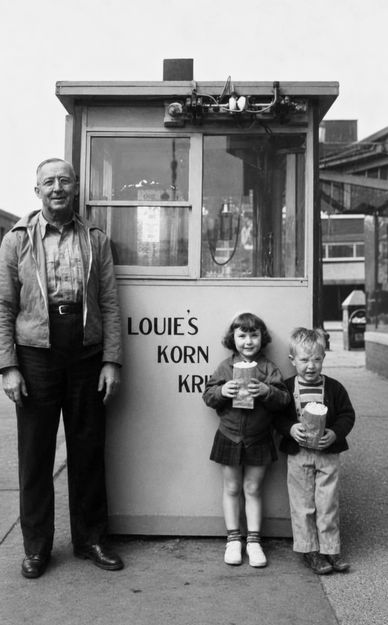
The 1940s — Louie's Korn Krib
Ethel Knudson died in 1941, the same year the United States entered World War II. Louie's Korn Krib continued operating and became particularly busy during the war years. Louie and Ethel's children, Joan and Jack, helped their father operate the family business. Popcorn itself became increasingly popular during World War II. Sugar rationing reduced the availability of candy, while popcorn required no rationed sugar in its basic form. Americans consequently turned to popcorn as an inexpensive snack.

World War II — Popcorn for the GIs
Perhaps the most touching chapter in Louie's history isn't about a location at all. It's about what Louie did with his popcorn profits during World War II. This remarkable piece of family history was shared by Louie and Ethel's grandson, Mike Cleavenger.
During the war, Louie used the profits from his popcorn business to send popcorn to American GIs serving overseas. The little popcorn business in Iowa Falls had become part of the war effort. But Louie did something else that would turn his generosity into a deeply personal connection with the servicemen receiving his popcorn. He included his name and Iowa Falls address with the popcorn he sent.
And the GIs began writing back. Letters arrived from servicemen far away from Iowa Falls—young men serving their country who had received a little taste of home because of Louie. Those letters meant the world to him.
According to Mike, Louie kept the letters beside his chair in the living room. At night, he would sit in his chair and read them. He treasured those letters. It's difficult to imagine a more meaningful piece of The Popcorn Stand's history. Every bag represented more than popcorn. It was a reminder to a serviceman thousands of miles from home that someone back in Iowa was thinking about him.
And for Louie, every letter that came back was something worth saving and reading again.
The Popcorn Stand wasn't simply operating during World War II—it was participating in the war effort.
May 1943 — Fire at the Stand
In May 1943, Louie's popcorn stand at Stevens and Washington caught fire. A clerk had briefly stepped away and accidentally left a switch on. The butter became too hot and burst into flames. People inside nearby Aborn's Drug Store spotted the fire and called the fire department. Water from a hand pump was used to extinguish the blaze. The interior and windows of the stand suffered damage, but the business survived.
1946 — 110,000 Bags of Popcorn
After the war, Louie's popularity showed no signs of slowing down. A newspaper profile reported that in 1946 alone, Louie sold an astonishing 110,000 bags of popcorn. The same account described Louie as someone was loved by both young people and adults in Iowa Falls. By then, generations of people had grown accustomed to seeing Louie and buying his popcorn. He had become part of Iowa Falls.

1948 - The Stand We Know Today -Arrives
This is one of the most important dates in the history of today's Popcorn Stand. Louie's Korn Krib installed a brand-new, modern popcorn stand. The metal-clad stand had been manufactured by Manley, Inc. in Kansas City and made its way to Iowa Falls by train.
It featured bright electric lighting and twin popping machines. This is the year that would forever connect Louie's name with the little metal popcorn stand people recognize today. The metal Korn Krib represented the next generation of a business that had evolved from popcorn wagons and earlier downtown stands.
1953 — The Stand Moves
The Korn Krib wouldn't remain in the same place forever. On May 1, 1953, street widening required the popcorn stand to be relocated. The stand was moved to: 324 Main Street This location was just south of Estes Street and east of the post office. Once again, the little popcorn stand adapted and survived.

1955 — 25 Years of Louie's Popcorn
A 1955 Iowa Falls Centennial advertisement for Louie's Popcorn Stand at 324 Main Street, celebrating 25 years in Iowa Falls. The advertisement proudly marked '25 Years in Iowa Falls - 1929 to 1955' and identified Louis Knudson as owner.
1957 — Louie Says Goodbye to the Business
After decades as Iowa Falls' beloved Popcorn Man, Louie's time behind the business eventually came to an end. Louie may have stepped away from the business, but the tradition he and Ethel had helped build continued.
Louie and Ethel couldn't have known that generations later, people would still be buying popcorn from the little business they helped create. They couldn't have known that the stand would survive moves, changing owners, changing streetscapes and more than three-quarters of a century. But it did. And the story of Louie’s Korn Krib lives on.
Family Legacy
Preserving the Knudson Family History, A very special thank-you belongs to Mike Cleavenger, grandson of Louie and Ethel Knutson, for sharing his family's memories and helping preserve pieces of this story that may never have been recorded in a newspaper. Mike's recollections preserve the story of the Metropolitan Theatre dispute, his grandmother Ethel's reaction to having to move the stand, Louie's extraordinary contribution to the World War II effort, the popcorn sent to American GIs, and the treasured letters Louie kept beside his chair and read at night.

Also Michele Skanes, grandaughter of Louie and Ethel Knutson. She is seen here (above) visiting The Popcorn Stand as a youngster. Although she never got to meet her grandparents the stand still holds a special place in her heart. She visited as an adult also. Seen here (below) with her dear cousin.


Mike & Michele's father, Casey Cleavenger (pictured above), son in law of the Knudson's visited The Popcorn Stand in his eighties, driving all the way from Washington state by himself. It was a huge compliment when he told the current owners that the popcorn was as good as it was when Louie made it.
The family memories that have been shared, add something dates and newspaper clippings alone cannot provide: They tell us who Louie & Ethel were. And they help ensure that the story behind one of Iowa Falls' most beloved traditions will not be forgotten.
1957 — Louie Sells the Business
In April 1957, after operating the popcorn business with his wife and children for nearly three decades, Louie Knudson sold the business to Darwin Dougan. Louie's chapter as owner had ended, but the little stand continued.
Ethel Knudson passed in 1941 and Louie Knudson passed in 1959. Their memory will always live on within An Iowa Falls Tradition.
1957-1959 - New Owners, Same Tradition
In April 1957, after operating popcorn machines with his wife and children for roughly 27 years, Louis Knudson sold the business to Darwin Dougan.
July 1958
Lewis and Harriet Musson of Alden took over and continued using the Louie's Korn Krib name. Lewis Musson died in early 1959.

1959- Jack & Eddie's Popcorn Stand
John and Edna 'Eddie' Ellefson purchased the stand after retiring from farming. The business became known as Jack & Eddie's Popcorn Stand.
1967 - The Stand Comes to Estes Park
In September 1967, John Ellefson leased the southeast corner of Estes Park for the popcorn stand. This move brought the little building to the park setting with which generations of Iowa Falls residents now associate it.

The Popcorn Stand in Estes Park in an earlier era, with its familiar POP CORN sign.
Over the years, children arrived with coins in hand, families stopped after community events, and the smell of popcorn drifted through the park. In 1974, even the smallest bag reportedly rose from a nickel to a dime - a tiny detail that captures how long this tradition has endured.
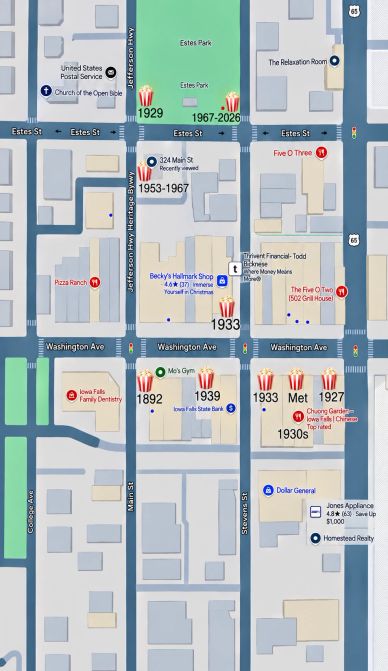
-A Map of Iowa Falls Popcorn History
The stand's history makes more sense when viewed alongside the many known places where popcorn was sold in Iowa Falls. The map below brings those locations together and shows how the tradition moved through downtown before the present stand settled in Estes Park.

1984-Jack & Eddie's
On May 13, 1984, Jack & Eddie's Popcorn Stand celebrated 25 years in business with free popcorn and gum for children. By then, the little stand had become far more than a seasonal concession - it was part of Iowa Falls life.
1995-The End of Era
After 36 years, a beloved chapter in the history of The Popcorn Stand came to a close.

1995 - Shirley Welden-Preserving a Local Landmark
After John Ellefson died, Eddie later sold the stand to Shirley Welden. Historical accounts say Shirley feared the stand might otherwise leave Iowa Falls, so she purchased it and worked to preserve it. Volunteers helped with renovation and repairs.
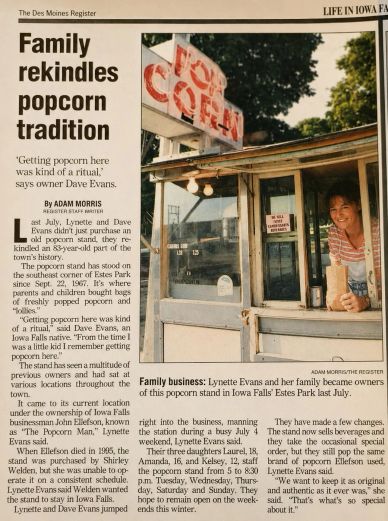
2003-Families Who Kept It Going
-Dave and Lynette Evans
In June 2003, Shirley Welden sold Jack & Eddie's Popcorn Stand to Dave and Lynette Evans. Their three teenage daughters planned to help operate it, continuing a pattern seen throughout the stand's history: families working side by side.

2008 Francis Fritz purchases the stand
2009 Major restoration preserves the historic structure
2010 Sharie and Denis Bruflodt
Sharie & Denis bought the stand. They owned and operated it with help from their sons, Alan and Bret.

2014-Present
2014-Present

Anthony and Lisa Senne
The Couple purchased The Popcorn Stand in 2014 and continue to run it as a family business. Their daughter, Hayley helped out when she was in high school. Their son Nikolas started helping when he was 12. The Senne's are carrying the tradition into another generation. While preserving the classic popcorn flavors and the stand's vintage character. The family expanded the popcorn flavors with a variety of choices.
The glowing POP CORN sign remains one of the stand's most recognizable features.
Read all about the Senne's Popcorn Journey on their page.